

Odisha showcases GI-tagged handlooms on 12th National Handloom Day
Odisha's Handlooms Department organised a fashion show on National Handloom Day featuring GI-tagged Dhalapathar and Tussar fabrics, Nuapatna sarees and Bargarh Double Ikat garments.
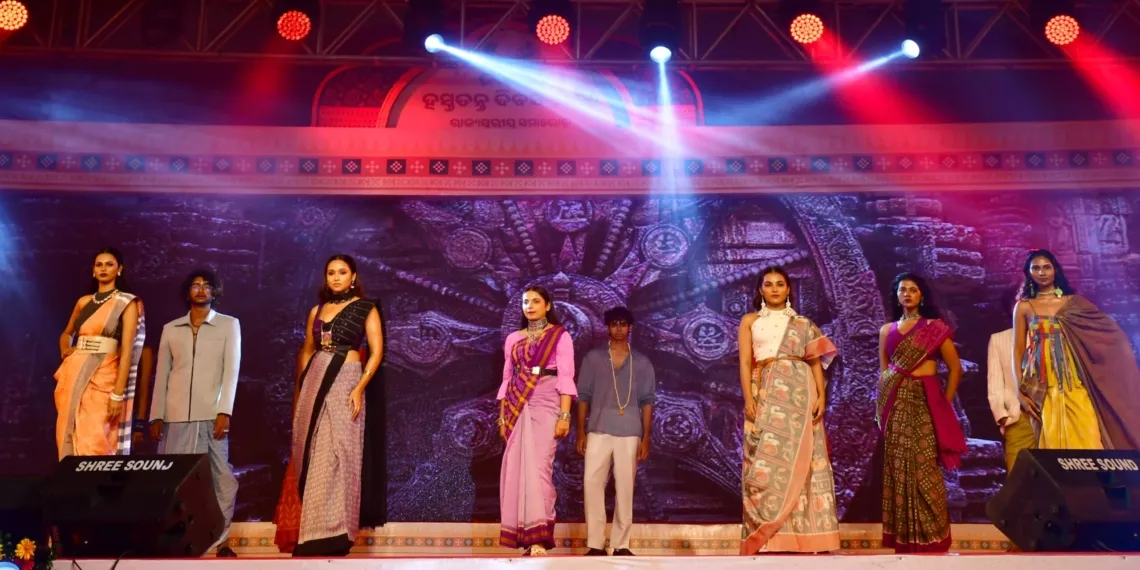
On the occasion of the 12th National Handloom Day, the Handlooms, Textiles and Handicrafts Department of the Government of Odisha organised a fashion show in Bhubaneswar on August 7, 2026.
The event was presented jointly by the National Institute of Fashion Technology (NIFT), Bhubaneswar, and Liva of the Aditya Birla Group. The show unfolded in four distinct sequences, each carefully curated to showcase the state’s rich textile heritage through a contemporary lens. The first two sequences, curated by NIFT, featured ten modern garments crafted from GI-tagged Dhalapathar curtains and fabrics — a traditional weaving art once used for temple hangings and royal drapes, now reinterpreted into elegant contemporary wear. This was followed by ten striking ensembles that highlighted the natural lustre, texture, and drape of Tussar silk, a wild silk indigenous to Odisha’s forested regions, prized for its eco-friendly production and golden sheen.
Liva then took over with two equally compelling presentations. Twelve exquisite sarees from the renowned Nuapatna cluster glided down the ramp, their intricate motifs — inspired by temple architecture, mythological tales, and natural motifs — telling stories of generations of craftsmanship passed down through artisan families. The final sequence brought Bargarh’s celebrated Double Ikat to life through twelve contemporary garments — six for men and six for women — proving that this complex, labor-intensive technique, where both warp and weft are resist-dyed before weaving, can look completely at home in today’s wardrobes, bridging tradition with modern silhouettes.
Beyond the visual spectacle, the evening carried a clear message of purpose. The show focused on three interconnected goals: sustainability, value-chain development, and greater global market access. By honouring age-old weaving methods while reducing environmental impact through low-impact dyes, water conservation, and waste minimization, the organisers aim to build lasting models of sustainable fashion that can serve as benchmarks for the industry. The event also sought to strengthen the entire ecosystem — linking weavers, designers, supply-chain partners, and retailers — so that Odisha’s handloom home and office textiles can reach international design markets with greater design-led appeal and commercial viability.
Adding further significance to the day, the Department of Handlooms, Textiles and Handicrafts signed a Memorandum of Understanding with Liva earlier in the morning at the Secretariat. The partnership will support regenerative fibre clusters, with a special focus on Lyocell — a sustainable, biodegradable fibre derived from wood pulp — reinforcing the state’s commitment to environmentally responsible growth and innovation in textile production. Officials noted that the MoU aims to create pilot clusters in Sambalpur and Bargarh districts, training over 500 weavers in Lyocell-blended weaving techniques within the next two years.
Senior officials, including Commissioner-cum-Secretary Smt. Guha Punam Tapas Kumar, Director of Textiles and Handlooms Sri Surya Narayan Pattanaik, Additional Secretary Madhusmita Behera, Joint Secretary Mamata Nayak, Special Officer Indira Behera, and other department representatives, were present to witness the celebration. They were joined by Prof. Dr. Vibhabari Kumar, Director of NIFT Bhubaneswar, along with Bhavna Mall, Subhendu Barman, and Priyanka Priyadarsini, Senior Vice President of Liva’s saree category from the Aditya Birla Group.
Speaking on the occasion, Smt. Guha Punam Tapas Kumar said, "This event is not just a fashion show — it is a declaration of intent. We are weaving together tradition and technology, heritage and hope, to ensure that Odisha’s weavers are not preserved as museum pieces, but empowered as pioneers of sustainable luxury."
Prof. Dr. Vibhabari Kumar of NIFT Bhubaneswar added, "Our students worked closely with master weavers for six months to translate ancient patterns into wearable art. This collaboration is the future of Indian fashion — rooted, responsible, and globally relevant."
Bhavna Mall of Liva echoed the sentiment, stating, "We see immense potential in Odisha’s handloom ecosystem. By integrating Lyocell and supporting regenerative practices, we’re not just creating beautiful garments — we’re building resilient livelihoods."
In its quiet yet powerful way, the evening reaffirmed the Odisha government’s continued dedication to its weaving communities, the nurturing of regional artisan clusters, and the ambition of placing the state’s handlooms firmly on the global fashion map. For one night in Bhubaneswar, every thread told a story of pride, progress, and possibility — a testament to the enduring legacy of Odisha’s weavers and their evolving role in shaping a sustainable, stylish future.
When was the fashion show organised for National Handloom Day in Odisha?
The fashion show was organised on August 7, 2026, on the occasion of the 12th National Handloom Day.
Which organisations presented the National Handloom Day fashion show in Odisha?
The show was presented jointly by the National Institute of Fashion Technology (NIFT), Bhubaneswar, and Liva of the Aditya Birla Group.
Which GI-tagged fabrics were featured in the first two sequences of the Odisha handloom fashion show?
The first two sequences featured ten modern garments crafted from GI-tagged Dhalapathar curtains and fabrics, followed by ten ensembles highlighting Tussar’s natural lustre.
Which handloom clusters were showcased in the Liva-presented sequences of the Odisha fashion show?
Liva presented twelve sarees from the Nuapatna cluster and twelve contemporary garments from Bargarh’s Double Ikat tradition — six for men and six for women.
What Memorandum of Understanding was signed by Odisha’s Handlooms Department on National Handloom Day 2026?
The Department of Handlooms, Textiles and Handicrafts signed a Memorandum of Understanding with Liva to support regenerative fibre clusters, with a special focus on Lyocell.
Sundargarh Mirror Team
Our staff writers report from across the ten districts of Western Odisha's Kosal region.

Loading…