

Balijhudi Market Preserves Odisha Handloom Traditions Through Direct Sales
Bargarh's Balijhudi market becomes a hub for Odisha's weavers to sell handwoven ikats directly, bypassing middlemen and preserving traditional craftsmanship.
by admin August 9, 2026
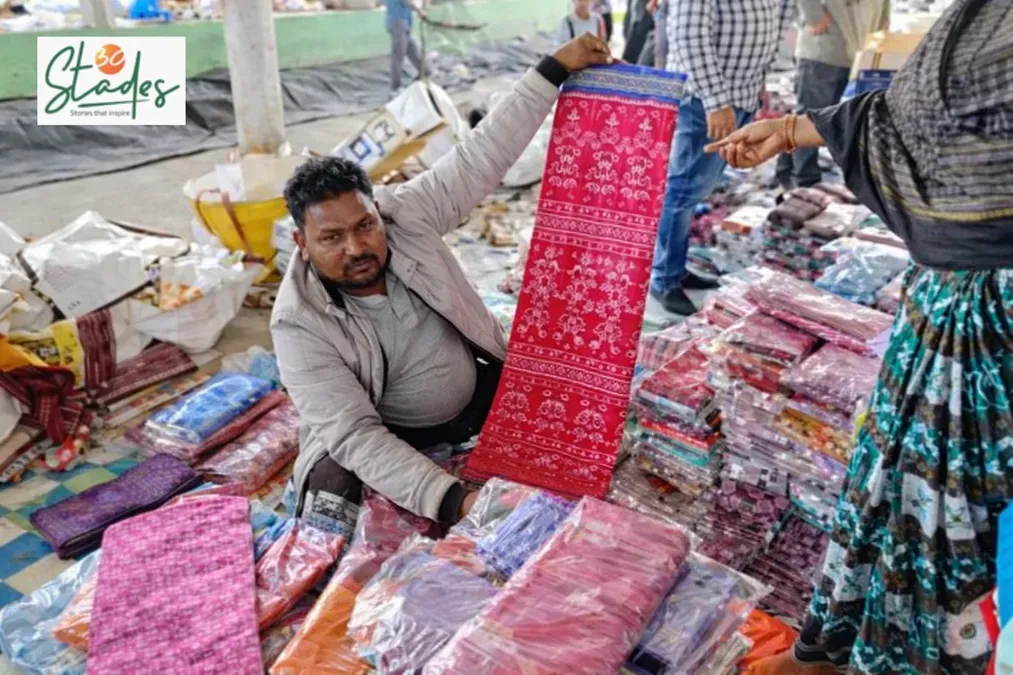
- Field notes from Balijhudi market, Bargarh, and from nearly two decades of visits to Odisha's weaving villages — alongside reflections on what it will take to carry this craft across the oceans. admin 7th August was declared the first National Handloom Day in 2015 by Prime Minister Modi to honor the multitude of weaving traditions and the weavers as artists. Here I want to highlight Odisha handloom, the unique identity of my home state, whose roots go back to ancient times, when Odia Sadhab Puas — traders — sailed the mighty Mahanadi out to the Indian Ocean, carrying Odisha textiles to Bali, Java, and Sumatra. Odisha is known above all for ikat, its designs varying across 35 dedicated handloom clusters that support over 192,000 active weavers. The number of weavers keeps shrinking, since a family’s average earnings from weaving come to less than ₹15,000 a month, roughly $150, and their children increasingly turn away from the craft to work as contract laborers in neighboring states. Before Dawn at Balijhudi Market One of my most memorable experiences with Odisha handloom was not at a showroom, an exhibition, or a government-sponsored event. It was 4:00 in the morning at a market in Bargarh, in the western region of Odisha. On 18th January 2026, I was in Sambalpur to give a lecture in the Political Science and Women’s Studies departments at Gangadhar Meher University. But my main attraction was the opportunity to visit Balijhudi market, Bargarh — known as the largest open-air market in Asia — where weavers come from far and near to sell their products directly to customers. A brilliant postgraduate student in Political Science from a weaver family of the Bhulia caste, Subham Meher, arranged to accompany me to this market in Bargarh, about 60 km away from Sambalpur. He drove me along with his parents and sister Lima the night before, and we stayed with their uncle, BichitraMeher, and his family in Bargarh. That evening, Bichitra Meher, an award-winning weaver whose father, mother, and brother are also awardees, became my teacher in Bandha design and weaving. We woke up around 4 am, and Subham drove us, along with Bichitra Meher and Lima, to the market at the end of the town. It is called Behera Bazar, popularly known as Balijhudi market, and it runs the whole night. In the morning, people disperse, and the day becomes quiet. What I saw in those wee hours has stayed with me ever since. The sky was still dark. Cars, trucks, and two-wheelers had lined up for almost a mile before the market started. We had to walk for about 30 minutes to reach the hustle and bustle of the market. Colors Everywhere Hundreds of weavers and buyers had gathered — from villages across Bargarh, Sonepur and neighboring clusters, and even from Chhattisgarh, the neighboring state — carrying freshly handwoven ikat textiles. The sellers were largely the weavers themselves, proudly displaying their own work. The buyers were wholesale marketers who had driven 500 kilometers from Cuttack and Bhubaneswar, as well as individual buyers. I saw a young couple beaming, the man holding a beautiful red and tallow ikat silk sari wrapped in a plastic bag, the woman with a small child. I asked how much they had paid for it. The price was not important. But the couple’s smile said they had found their treasure, and the man could not wait to see his young wife in that beautiful sari.
While watching the weavers sell their products, I noticed they were collecting payment directly from consumers. There was something deeply empowering about watching the weaver who created the textile standing directly in front of the person buying it. No middleman in between. While watching the weavers sell their products, I noticed they were collecting payment directly from consumers. There was something deeply empowering about watching the weaver who created the textile standing directly in front of the person buying it. No middleman in between. That is the future of handloom I envision to see overall improvement in the lives of the weavers. Balijhudi market is built around the weaver. It has been there for generations; the market association’s president, Ajodhya Meher, and secretary, Siva Meher, told me. In 2002, with increasing demand for space, it moved to this seven-acre site. “The product has to be handloom,” Mehersaid — “no room for copy designs, synthetics, or powerloom.” One weaver told me that 40 weavers work with him and that he had brought their products here to sell on their behalf. Some buyers even arrange meetings in advance to collect specific textiles in bulk. The energy is remarkable. Even so, weavers I talked to that morning worried about pirated versions of their designs finding their way onto the market, and about government support that is too often absorbed by cooperative societies before it reaches the individual weaver. This night market is not merely a place where saris are sold. It is an ecosystem — connecting production with demand, letting weavers interact directly with customers, and giving them a sense of ownership over the product and its sale. I remember being enchanted by the extraordinary range of colors and the names carried by the saris — Gajagamani, the graceful gait of an elephant; Mriga Nayani, the enchanting eyes of a deer; Hansa Chali, the elegant walk of a swan. The border motifs are drawn from fish, birds, flowers, fruits such as rudraksha. Half a World Away Last week, at a dinner at a friend’s home in the Bay Area, I noticed several men wearing beautiful Odisha ikat shirts paired effortlessly with western trousers. I complimented a senior member of our community on his Sambalpuri shirt. His face lit up. He told me enthusiastically that he had several Sambalpuri shirts and had decided to wear one that evening. He was beaming with pride. I felt an expansion of Balijhudi market and an appreciation of the weaver’s crafts. I could not help thinking of the weaver who had made that shirt, and of the market where he might have sold it directly, at dawn, to someone who would carry it thousands of miles. Today, it is increasingly common in the North American diaspora — not only for women but also for men — to wear Odisha handloom garments: shirts, jackets, kurtas, sherwani sets, and sarees. Not just during Odisha Day, Rath Jatra, Bahuda, OSA conventions, or weddings, but also on ordinary festive occasions and when visiting one another. This is precisely the transformation we need to accelerate: from handloom as occasional traditional attire to handloom as contemporary, desirable, everyday global fashion. On this National Handloom Day, let us celebrate not merely the beauty of the fabric, but the dignity of the person who creates it. Let us make handloom aspirational. Let us make weaving remunerative. Let us make young people proud to inherit and reinvent their family’s craft. And most importantly, let us take Indian handloom beyond borders — from our villages to the global marketplace. Every handwoven garment we choose is more than clothing. It carries the hands, history, culture, and creativity of the weaver community. We must wear it, share its story, and try to buy directly from weavers and introduce it to the world. The future of handloom will not be secured merely by preserving the past. It will be secured by making our heritage relevant, desirable, and economically sustainable for the future.
Annapurna Devi Pandey taught Cultural Anthropology at the University of California, Santa Cruz.
What's Your Reaction?
Excited 0 Happy 0 In Love 0 Not Sure 0 Silly 0 0 Comments Share Tweet Pin Share
Related Coverage
What makes Balijhudi Market unique?
It allows weavers to sell directly to buyers without intermediaries.
How many weavers operate in Odisha?
Over 192,000 active weavers across 35 clusters.
What is the average monthly income for weavers?
Less than ₹15,000, equivalent to about $150.
Why is direct sales important for weavers?
It empowers them by removing middlemen and ensuring fair prices.
What threat do weavers face?
Pirated designs and inadequate government support reaching individuals.
Snehalata Bariha
District Correspondent, Bargarh
Snehalata Bariha covers Bargarh's paddy-belt agriculture, farmer welfare schemes, and the Dhanuyatra festival beat from her base in Bargarh town.
View all articles by Snehalata →
Loading…